Painting Over Oil-Based Paint in Portland Homes
How to tell oil paint from latex, the two ways to make latex stick to it, and the lead rules that come first in a pre-1978 Portland house.
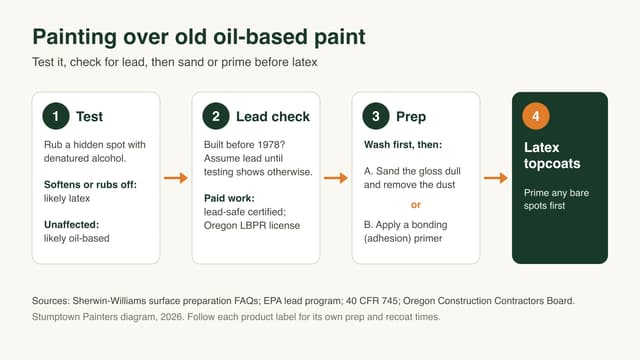
Yes, you can put latex paint over oil-based paint, but not straight from the can. Sherwin-Williams gives two ways to do it: wash the surface, sand it dull and clean off the dust before the latex goes on, or wash it and apply an adhesion (bonding) primer first. Skip both and the new coat has nothing to grip on hard, glossy oil paint, so it is likely to peel.
In Portland there is a second step that comes before the sandpaper. The city's housing is old (the median home was built in 1966), many older houses carry decades of paint layers, and you cannot tell by looking which of them are oil. Sanding paint in a house built before 1978 can raise lead dust, so the order is test the paint type, check for lead, then prep. This guide walks through each step, the two prep routes, and what to do when latex is already peeling off oil.
Why latex peels off old oil-based paint
Cured oil (alkyd) paint dries to a hard, slick film, often in a gloss or semi-gloss sheen. Sherwin-Williams' problem guide on peeling over hard, slick surfaces says any primer, paint or stain applied to that kind of surface is likely to peel, because adhesion is hard to get without a surface profile for the coating to grip. Its fix is the same as the prep below: clean, scrape off anything loose, sand glossy areas dull, and use a bonding primer if the surface is still slick.
Two other things undermine the new coat:
- Dirt and residue on sheltered surfaces. Portland averages 36.92 inches of rain a year (NOAA 1991–2020 normals, Portland International Airport), but soffits, porch ceilings and the siding under deep eaves never get rinsed. Sherwin-Williams' article on intercoat peeling in protected areas says contaminants build up there because “the natural cleaning effect of weathering does not occur,” that salts from the old coat can leave an invisible film, and that old hard, glossy films add to the problem. It asks for extra prep attention in those spots.
- Chalk. Sherwin-Williams notes that gloss alkyd paint exposed to harsh weather tends to chalk, and that any chalky surface has to be cleaned before painting. New paint over chalk sticks to the powder, not the wall.
How to tell if paint is oil-based or latex
If no labeled can survives from the last paint job, test the surface itself. Sherwin-Williams describes two quick checks in its exterior surface preparation FAQ:
- The alcohol rub. Dampen a rag with denatured alcohol and rub a small, out-of-sight spot. If the paint softens or rubs off onto the rag, it is most likely latex. An alcohol test usually does not affect oil-based paint.
- The bend test, for a chip that is already loose. If it is flexible and bends easily, it is probably latex. If it is hard and brittle and snaps instead of bending, it is most likely oil-based.
Two clues point the same way. Sherwin-Williams says alkyd paints tend to yellow, especially where sunlight does not reach, such as inside closets and behind pictures, so old white trim that has gone cream in the shade is worth testing. And on a house exterior, patterned cracking that looks like reptile scales (alligatoring) is linked in its alligatoring article to aging oil-based paint.
Test each surface separately. A house can have latex walls, oil trim and a door painted a third way, and a result on one says nothing about the next. When a test is unclear, treat the surface as oil and prep it that way: the extra step costs less than a peeling repaint.
Pre-1978 house? Do the alcohol rub on a spot that is intact, and do not scrape or sand to get a sample. Disturbing the paint is what the lead rules below are about.
Before you sand: lead in Portland's older homes
The federal government banned lead-based paint for homes in 1978, and the EPA's estimates by era show how likely an older house is to have it somewhere. Set against Portland's own housing, from the U.S. Census Bureau's American Community Survey (2020–2024 five-year estimates for the city of Portland):
| Year built | Homes likely to have lead-based paint (EPA) | Share of Portland housing units (ACS) |
|---|---|---|
| Before 1940 | 87% | 26.8% |
| 1940–1959 | 69% | 18.4% |
| 1960–1977 | 24% | 8.1% for 1960–1969; the Census groups 1970–1979 together |
Sources: EPA, “Protect Your Family from Sources of Lead”; ACS 2020–2024 5-year, table B25034, Portland city. More than half of Portland's housing units were built before 1970.
The EPA singles out old paint on surfaces that rub, such as doors and window sills, as a source of hazardous chips and dust, and those are the same glossy surfaces that need deglossing before latex. What that means in practice:
- Testing. The EPA recognizes three test kits, and only for negative results: LeadCheck and D-Lead in the hands of a certified renovator, and the Massachusetts kit used by trained professionals. A certified inspector or risk assessor can also test. Oregon treats a pre-1978 home as containing lead paint unless testing shows otherwise.
- Hiring the work out. Anyone paid to disturb paint in a pre-1978 home must be certified in lead-safe work practices, and Oregon, which runs its own EPA-authorized program, requires a Lead-Based Paint Renovation (LBPR) license from the Construction Contractors Board before a contractor can even bid. The federal rule exempts only small jobs: 6 square feet or less of painted surface per room inside, or 20 square feet or less outside (40 CFR 745.83). Sanding every door and casing in a room goes well past that.
- Banned methods on covered jobs. No open-flame burning, no power sanding or grinding unless the tool is shrouded and attached to a HEPA vacuum, and heat guns only below 1,100°F (40 CFR 745.85).
- Doing it yourself. The EPA says the federal rule generally does not apply to homeowners working on their own home, unless it is rented, used for child care or being flipped, and the CCB exempts owners doing their own work from the LBPR license. The hazard is the same either way. The EPA's advice if you must sand: wet the area first, sand the minimum needed and clean up thoroughly.
Our guide to painting a pre-1978 home in Portland covers lead-safe setup and cleanup in more detail, and the lead-safe painting page explains what that work involves.
Two ways to get latex to stick to oil paint
Sherwin-Williams' interior surface preparation FAQ answers the question directly: latex can go over an oil-based finish by either of two routes. Both start with a wash, because neither sanding nor primer bonds to grease, grime or chalk.
| Step | Route 1: sand, then latex | Route 2: bonding primer, then latex |
|---|---|---|
| 1 | Wash the surface clean and let it dry | Wash the surface clean and let it dry |
| 2 | Sand until the gloss is gone | Apply an adhesion or bonding primer |
| 3 | Remove all the sanding dust | Let it dry for the recoat time on the label |
| 4 | Apply the latex topcoats | Apply the latex topcoats |
Source: Sherwin-Williams interior and exterior surface preparation FAQs. Bare wood or bare spots still need an appropriate primer on either route.
Route 1 suits surfaces in good shape with no lead question: a newer house, or paint that has tested negative. The sanding is a scuff to take off the shine, not a strip back to wood.
Route 2 cuts down on sanding, which helps on detailed trim and on pre-1978 surfaces where less dust is better. For glossy interior doors and trim, Sherwin-Williams says to use an adhesion primer and that the surface still has to be washed first. Bonding primers are sold for exactly this job. Examples from the makers' own pages: Sherwin-Williams Extreme Bond Primer, described as made for hard, glossy surfaces, with sanding that “may not be necessary for most clean, paintable surfaces”; and Benjamin Moore's INSL-X Stix Waterborne Bonding Primer, listed as adhering to glossy surfaces with a 3 to 4 hour recoat. Read the label of whatever you buy for its own prep and recoat rules.
Not sure the primer will hold? For a surface of doubtful adhesion (its example is paneling with a vinyl feel), Sherwin-Williams suggests you test the primer on the surface first and carry on only if it dries without lifting or blistering. The same habit works on old trim. A day spent on a test patch behind a door is cheap insurance on a whole room of trim.
Exterior siding and trim
Outside, the same rules apply with weather added. Sherwin-Williams' exterior FAQ answers “Yes, to both questions” when asked whether acrylic latex can go over gloss alkyd and whether special prep is needed: wash, sand the glossy areas so the paint can grip, wash off chalk and prime bare spots. Give porch ceilings, soffits and siding under the eaves an extra-thorough wash, and before repainting around any peeled patch, check the paint 6 to 12 inches out from it to make sure the surrounding coat is still firmly attached. For old hardboard (Masonite) siding, Sherwin-Williams recommends an exterior alkyd primer under two coats of acrylic latex house paint, and replacing boards that have swollen from water. The exterior prep guide covers washing, scraping and caulking, and the Portland exterior painting calendar covers the weather.
Interior trim, doors and cabinets
Trim and doors get handled, so adhesion matters more than on a wall. Kitchen cabinets with an old oil finish need the most care: Benjamin Moore's ADVANCE data sheet asks for surfaces free of grease, glossy areas dulled and cabinetry sanded with 220-grit or coarser before priming, and it says to wait at least 5 to 7 days before heavy wear or putting shelves back into service. Weighing a cabinet repaint against new boxes is its own question, covered in cabinet painting vs. replacement. For the sheen that suits trim, see the paint finish guide.
Should you switch to latex or stay with oil?
The makers' own pages give the case for latex. Benjamin Moore's note on alkyd paint says conventional alkyds use petroleum-based solvents, carry higher levels of volatile organic compounds (VOCs) and need paint thinner for cleanup. Sherwin-Williams says repainting with latex reduces yellowing, though the new coat can still yellow if the conditions behind it, such as heat or smoke, continue.
If you want the smooth, hard look of oil on trim and cabinets without the solvent, waterborne alkyd enamels are the middle ground. Benjamin Moore describes its ADVANCE line as having the flow and leveling of an oil-based paint with soap-and-water cleanup. They still need the same prep over old oil paint.
Staying with oil outside means planning around the weather. Sherwin-Williams says the first 8 hours or so of an oil-based product's cure are critical for rain resistance and advises against painting when rain is in the immediate forecast. Our guide to how long paint takes to dry compares dry and recoat times for both kinds.
Latex already peeling off oil paint: how to fix it
More paint on top will not hold a peeling coat down. The repair in Sherwin-Williams' peeling article is to go back to sound paint and redo the prep:
- Wash the area and let it dry.
- Scrape and sand away the peeling coat down to paint that is still firmly attached.
- Sand the remaining glossy oil paint dull, and if it still feels slick, apply a bonding primer.
- Test the paint 6 to 12 inches beyond the peeled edge before repainting.
On a pre-1978 house, steps 2 and 3 disturb old paint, so the lead rules above apply. Alligatored oil paint is a bigger job: Sherwin-Williams' repair for that pattern is to remove the old paint, which on an older house means lead-safe methods and, for paid work, a contractor licensed for it. For other symptoms, the paint problems guide explains what peeling, blistering and cracking usually point to.
What to do with old oil-based paint cans
Leftover oil-based paint, primer, stain and varnish can be recycled. Oregon's PaintCare program accepts house paint, primers, stains, sealers and clear coatings such as shellac and varnish, with no charge to drop off. Where to take it in the metro, including the Washington side, is on our paint recycling and disposal page.
Planning to repaint oil-painted trim, doors or siding? Ask any painter you talk to how they will test the old paint and which prep route they plan to use, and on a pre-1978 house, check their CCB and LBPR licenses. The project request form takes about a minute.
Common questions
Can you paint latex over oil-based paint?
Yes, with prep. Sherwin-Williams says to either wash the surface, sand it dull and remove the dust before applying latex, or wash it and apply an adhesion (bonding) primer before the latex topcoat. Without one of those steps, latex has little to grip on hard, glossy oil paint and can peel.
How can I tell if my paint is oil-based or latex?
Rub a hidden spot with a rag dampened in denatured alcohol. If the paint softens or comes off on the rag, it is most likely latex; alcohol usually does not affect oil-based paint. A loose chip that bends is probably latex, while one that is brittle and snaps is most likely oil.
Can you paint over oil-based paint without sanding?
Usually, if you wash the surface and use a bonding primer made for glossy surfaces. Sherwin-Williams says glossy interior doors and trim can take an adhesion primer instead of sanding but still need cleaning. Follow the primer label, and try it on a small area before doing the whole job.
Do I need to test for lead before sanding old oil paint?
On a house built before 1978, yes. EPA estimates put lead-based paint in 87 percent of homes built before 1940 and 69 percent of those built from 1940 to 1959. Anyone paid to disturb that paint needs lead-safe certification, and in Oregon a CCB Lead-Based Paint Renovation license.
Why is my latex paint peeling off my trim?
Often because it went over glossy oil paint, dirt or chalk without sanding or a bonding primer. Scrape and sand back to firmly attached paint, dull the remaining gloss, prime with a bonding primer and test the paint around the repair before repainting. On a pre-1978 house, follow lead-safe rules.
Can you put oil-based primer under latex paint?
Yes. Sherwin-Williams recommends an exterior alkyd primer under two coats of acrylic latex house paint on old hardboard siding, and it recommends alkyd stain blockers for water-stained ceilings. Let the primer dry for the recoat time on its label before the latex goes on.
Services this guide covers
- Interior Painting
Walls, ceilings, trim, accent walls, and whole-home interior repaints, priced room by room.
- Exterior Painting
Full-house repaints, siding, trim, doors, and stucco recoating, with prep spelled out in every quote.
- Lead-Safe Painting (Pre-1978)
Certified lead-safe exterior and interior painting for homes built before 1978.
Paint problems this guide explains
Keep reading
- GuidePainting Your House Before You Sell in PortlandWhich paint problems FHA appraisers, inspectors and buyers flag, the lead rules for pre-1978 homes, and what to repair, touch up or leave before you list.
- GuideHow Long Does Exterior Paint Last in Portland?What USDA research says about paint life on each kind of siding, why sunny walls wear out first, and how to tell when your house is due.
- GuidePainting a Pre-1978 Home in Portland: Lead Paint, Prep, and SafetyWhat lead-safe certification means and why it matters for older Portland houses.
- Free toolPainting cost calculatorA Portland-metro range for your house in under a minute.
Painting guides by city
More reading: all painting guides